Growing enough: How Aweside Farm is rethinking resilience
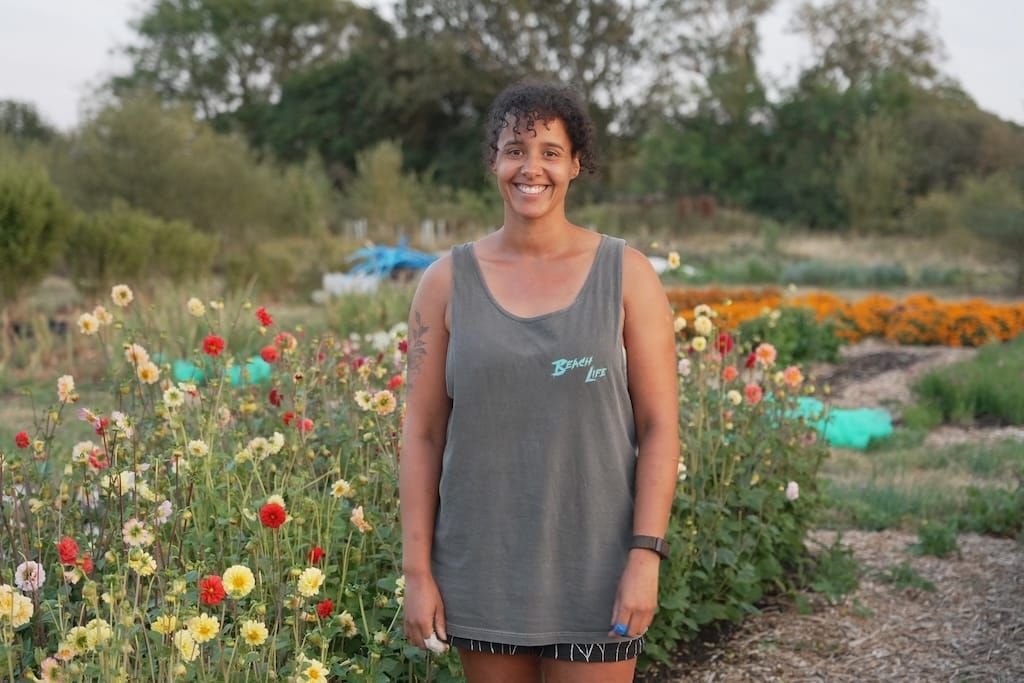
In the twelfth and final instalment of my twelve-part Indie Farmer series, supported by the Lund Trust and the High Weald National Landscape, I visited Aweside Farm near Arlington, East Sussex, where first-generation farmer Sinead Fenton is growing organic edible flowers, herbs and garnishes while rethinking how to build a more resilient farm, business and way of life.
After six years building an organic edible-flower farm on an exposed patch of East Sussex, Sinead Fenton is rethinking what resilience really means - for the land, the business and herself.
At Aweside Farm, the evidence of six years’ growth is everywhere. Willow whips planted at little more than 30 centimetres tall now form a substantial windbreak. Sea buckthorn is heavy with orange berries. Hedgerows are beginning to link the woodland on one side of the farm with a reservoir on the other, turning what was once a bare stretch of grass into a corridor for wildlife.
But the most revealing part of the farm this summer is not what has grown. It is what has disappeared.
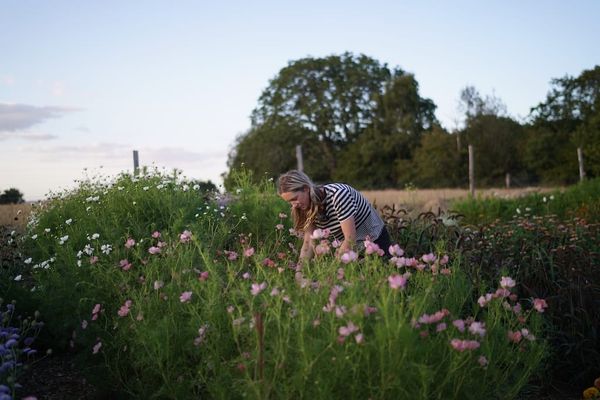
A patch that should be a sea of orange, yellow, blue and purple is largely bare. Cornflowers, calendula and borage — normally dependable crops for Sinead Fenton’s edible-flower business — raced through their flowering cycles or failed altogether in the prolonged heat. A succession that might usually produce for two months lasted around two weeks.
“Every year, the only thing I’ve decided is fully consistent is that every year I say: this gets worse,” says Sinead. “Doing this job just gets harder and harder.”
It is a blunt assessment, delivered with the dry humour familiar to anyone who follows Aweside Farm online. Yet beneath it lies a serious question. After years of responding to one crisis after another through sheer effort, can the farm be redesigned so that survival does not depend on Sinead continually pushing herself beyond her limits?
From a blank field to a working farm
Sinead arrived at the Arlington site in 2020, bringing an edible-flower business that had begun on a small rented plot in East London. Today Aweside comprises four and a half acres devoted to organically grown edible flowers, herbs and specialist leaves, supplying chefs and food businesses with ingredients including bronze fennel, cornflowers, borage, nasturtiums, Mexican marigold and oxalis.
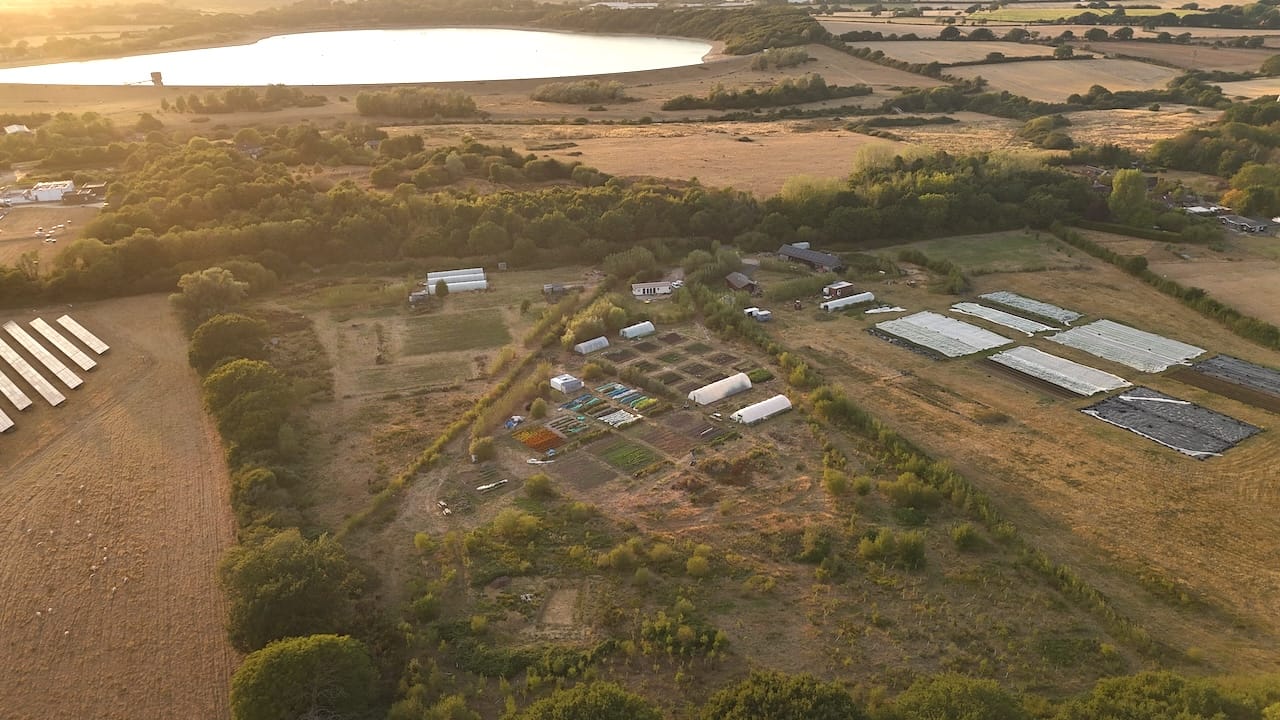
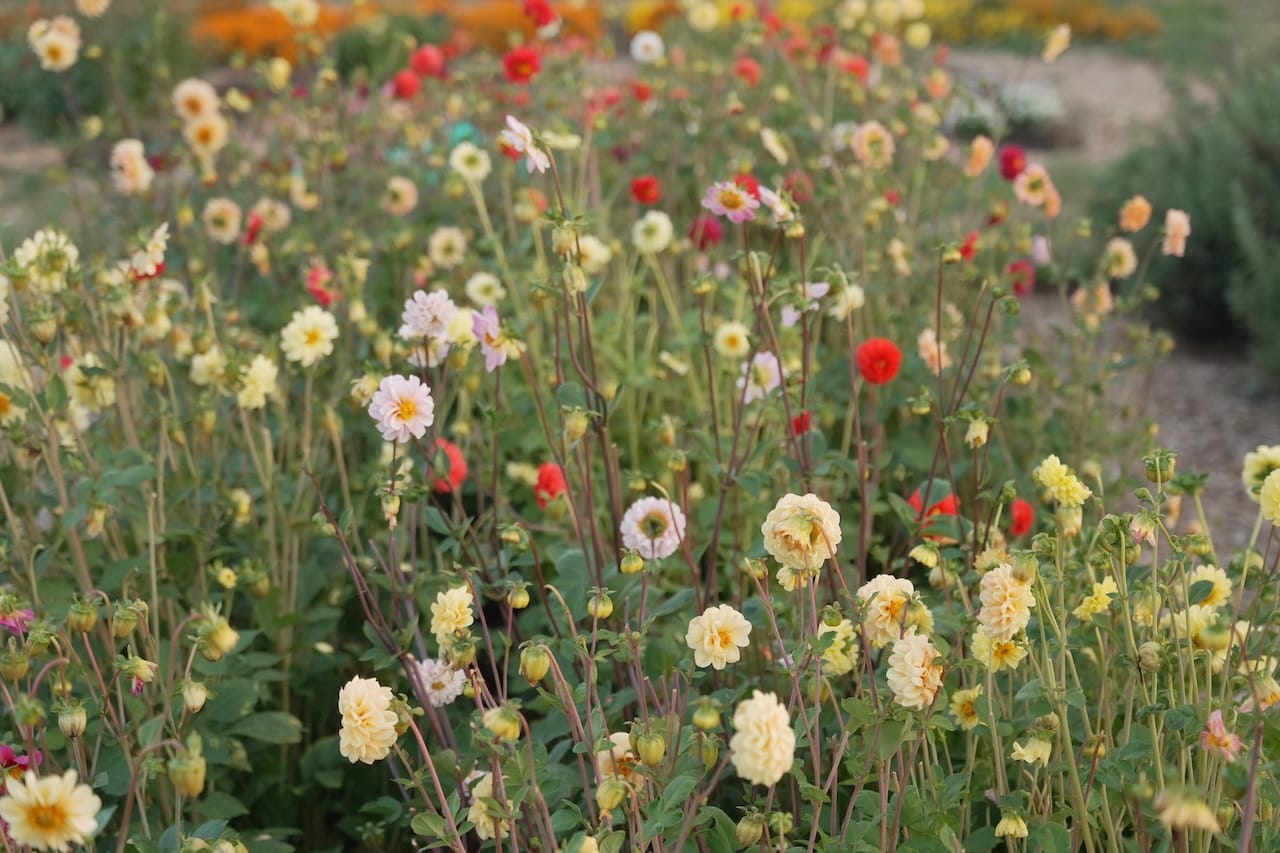
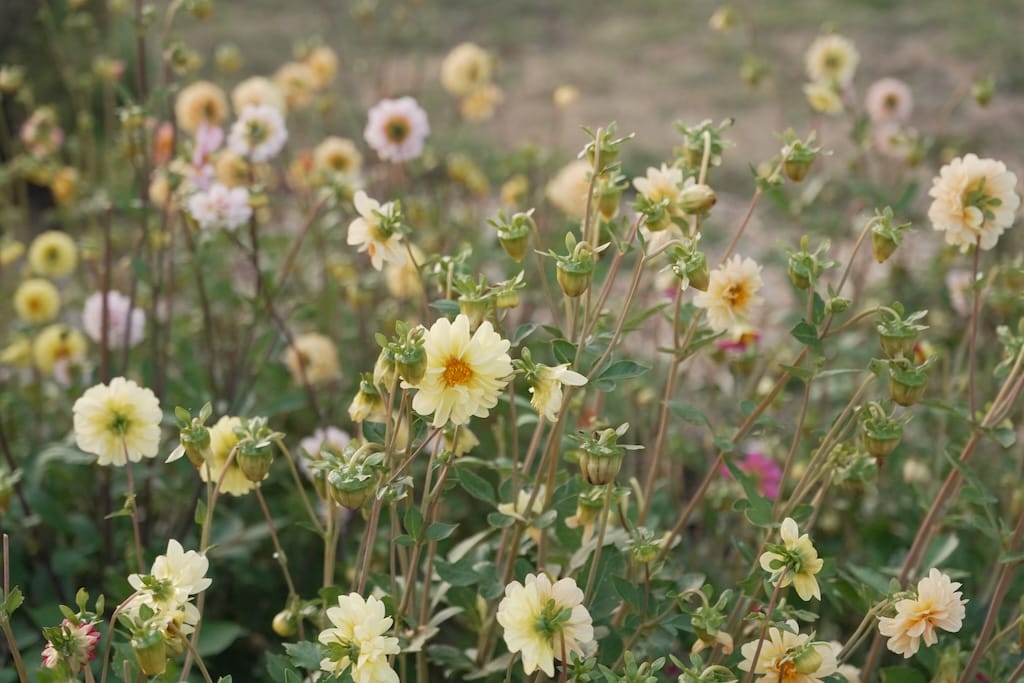
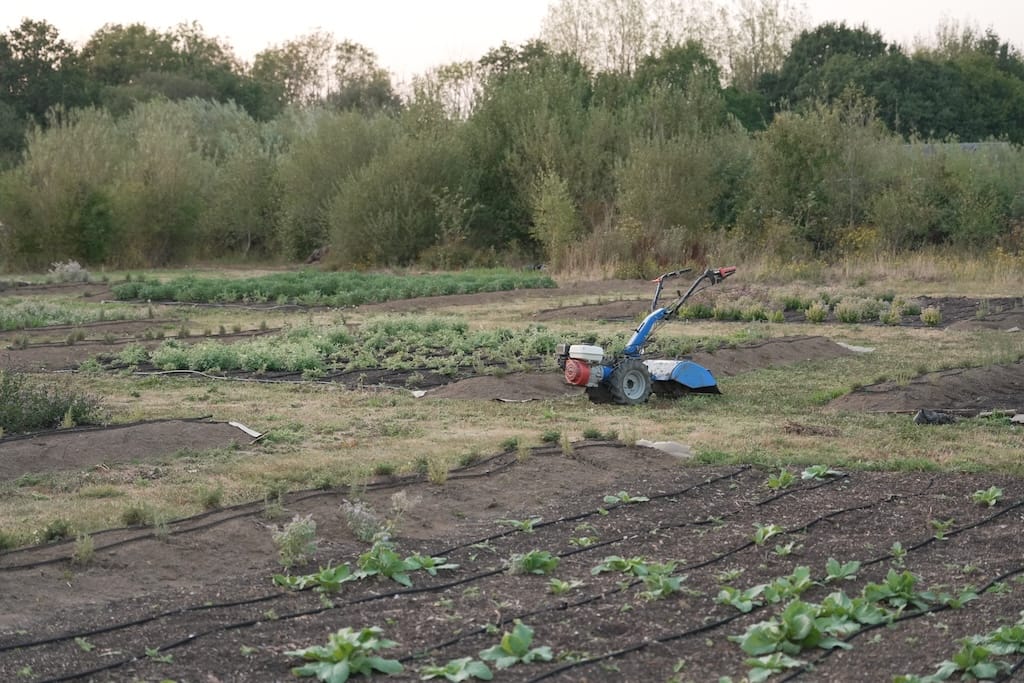
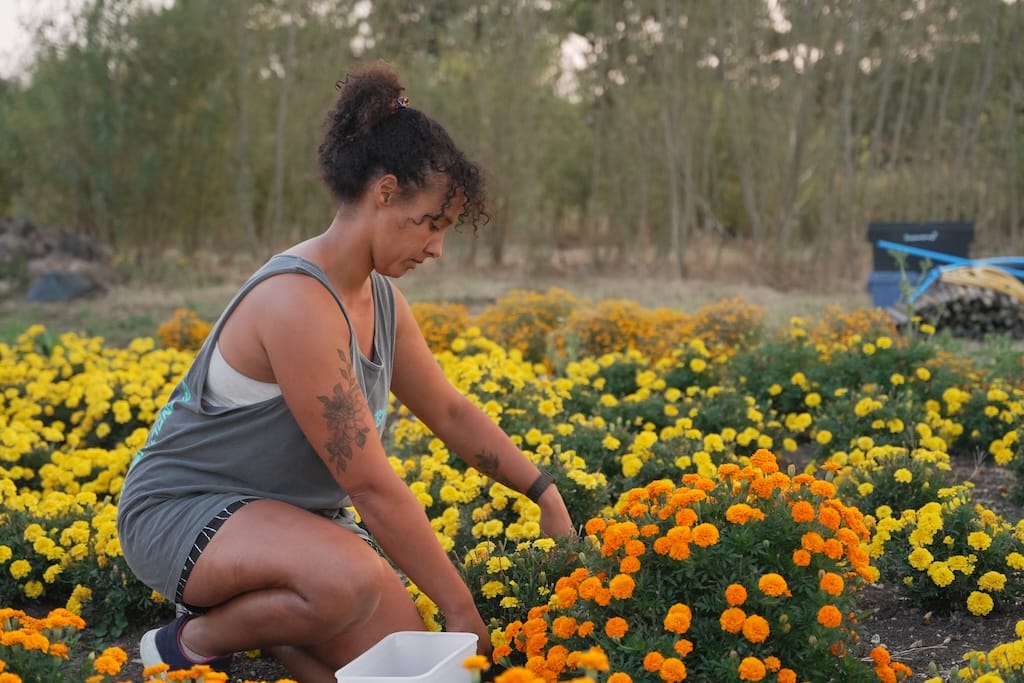
When she first came to East Sussex, the land was effectively a blank canvas. Sinead planted hundreds of metres of hedgerow and thousands of trees, established polytunnels, an orchard and a no-dig growing system, and created habitat across ground that had previously offered little shelter or diversity.
The transformation is visible, but it was achieved under pressure. Because the farm’s home and livelihood depended on demonstrating that the business was viable, there was little scope to leave ground unproductive or to learn slowly. The clock had already started before Sinead arrived; disruption from the pandemic then compressed the time available to establish customers, infrastructure and turnover.
“We rushed with some of this stuff,” she admits as we walk through an orchard that has struggled in the exposed conditions. “We didn’t want to leave any space open, because then it was: ‘What are you using that for? You’re not utilising the whole space.’”
The farm met its financial targets and eventually secured permanent planning permission. But the effort came at a cost. For several years, every bed had to justify itself, while the possibility of losing the place remained in the background.
“Now I actually want to build this farm in the way that maybe I dreamed of ten years ago,” she says, “before being eaten by the machine a bit, and chasing the money.”
The problem with 198 beds
Aweside’s original growing area followed a familiar no-dig market-garden pattern: long, narrow beds roughly 75 centimetres wide, separated by woodchip paths. There were 198 of them.
It was productive, but the system created its own burden. Every bed needed a crop; every path needed replenishing; every succession generated another decision. Sinead found the sheer number of spaces intimidating.
Last year she cut much of it down, covered the ground and began again. The new design uses large six-metre squares planted with perennial and semi-perennial herbs including chives, garden mint, chocolate mint, lemon balm, Moroccan mint, sage, oregano, pineapple mint, garlic chives and Mexican marigold.
Around the beds are low mounds planted with thyme and rosemary. As the rosemary grows, Sinead hopes it will provide both wind protection and shade. Espalier fruit trees will eventually add another layer and another crop.
The change is partly about reducing maintenance, but it is also a direct response to a changing climate. When Sinead established the farm, she orientated beds north to south to maximise sunlight. Now she is deliberately designing to reduce it.
“I realised that was a mistake, because I don’t want to maximise the sun any more,” she says.
That rethink proved timely. In a season when many of the edible flowers failed, the diversified herb beds offered a measure of protection. “If I did not do this this year, I think I would have been pretty ruined,” she says.
Some failed areas will now be sown with green manure and rested for a year. Elsewhere, Sinead plans to replace more annuals with perennials, build further shelter and use fruit trees within the productive growing system rather than treating the orchard as a separate block. It is a slower, more layered approach: one designed around the actual conditions of the site rather than an idealised market-garden template.
When the staples stop being staples
Edible flowers can appear delicate and decorative on a restaurant plate, but their production is highly exacting. Chefs may order tiny quantities of leaves or flowers, each of which must be picked by hand, cooled, packed and dispatched quickly.
At Aweside, bronze fennel is one of the most reliable crops, producing from early spring into late autumn and accounting for as many as 60 to 70 boxes a week. Its leaves, flowers and seeds can all be sold, allowing Sinead to rotate harvesting and give plants time to recover.
Other bestsellers include cornflower, borage, nasturtiums and dill flowers. This summer, bronze fennel was the only one of that group to perform consistently.
Heat accelerated the flowers’ instinct to set seed. Wind dried the ground almost as quickly as it could be watered. Deer, under pressure from the drought, began eating crops they would normally leave alone. Flea beetles tore through tunnel-grown plants. Sinead was repeatedly forced to decide whether another round of irrigation and labour was justified, or whether it was better to accept the loss and cover the ground.
“Every year we’re thrown such a big curveball,” she says. “It’s the energy to keep bouncing back, and to constantly keep having ideas. A lot of us will keep going, but what is the energy cost that comes with the constant trying?”
That question reaches beyond Aweside. Farmers are routinely praised for resilience, a word that can conceal as much as it celebrates. The ability to endure is valuable, but it can also allow unhealthy working conditions to become normal.
“When you’re living quite rough and doing this type of work, that becomes part of the grit and determination,” says Sinead. “People call it resilient; people call it strong. But it can become quite a dangerous spiral.”
Fresh flowers, dried possibilities
Inside Aweside’s packing shed, shelves of dark tins point towards another version of the business. Sinead and her mum are drying Moroccan mint and experimenting with powders, herbs and edible petals that can be sold throughout the year.
Fresh produce still accounts for roughly 80 per cent of sales, with preserved products making up the remaining 20 per cent. Sinead would like that balance to shift.
There are practical reasons. Dried products are shelf-stable, can travel further and can be processed in larger batches. Stored in dark reusable tins, herbs and flowers retain their colour, while customers can return the packaging to be refilled. The model creates less plastic waste and removes some of the relentless urgency associated with fresh orders.
It is also easier on the body. Harvesting five grams of perfect fresh garnish can mean repeated bending, kneeling and reaching into awkward spaces. After injuries to her hand and back, and with surgery scheduled for the autumn, Sinead has been forced to confront the physical limits of doing almost everything herself.
“I think I need to do less,” she says. “I need to give my back less bending for a good stint of time.”
She is testing whether some herbs might be dried naturally on mesh tables inside an otherwise underused polytunnel during summer, reducing pressure on the dehydrator. For products that need tighter food-safety controls, the dehydrator will remain essential, but tea-grade herbs may offer more flexibility.
The preserved range also feels closer to the environmental ambitions behind Aweside. A tin of dried petals can last far longer than a plastic punnet of fresh flowers with only a few days of usable life. Sinead believes chefs can obtain much the same visual effect while buying a product with a longer season and lower packaging burden.
For a grower who has proved she can create a successful niche in fresh edible flowers, the difficult task is not starting something new. It is allowing herself to step away from the part of the business that already pays the bills.
The hidden weight of being small
Diversifying into preserved products brings its own complications. Aweside is working towards SALSA food-safety certification, a process that has already generated around 190 pages of documents alongside physical changes to the packing space, cold storage and polytunnels.
The farm also holds separate organic producer and processing licences because it dehydrates its own crops. For a small business, the fees, paperwork and infrastructure requirements are substantial.
“You’ve got to grow the business big enough that you can get someone to do that work,” says Sinead, “and make sure they’re paying for themselves.”
The dilemma is familiar across small food and farming enterprises. Compliance can unlock new customers and reassure buyers, but the burden is rarely scaled to the number of people available to carry it. The grower is also the production manager, picker, packer, marketer, salesperson, administrator and maintenance team.
Sinead’s mum has provided vital help with drying and orders this summer, and she hopes to employ someone part-time next season. Reducing the farm’s dependence on one person is not simply a growth ambition; it is becoming a condition of making the business sustainable.
Making room for a life
The biggest change at Aweside may ultimately happen on the near side of a hedge. The new home has central heating and a genuinely hot shower — ordinary comforts that feel remarkable after years in a cold caravan. For the first time, Sinead can see the beginnings of a boundary between where she lives and where the work starts.
She wants to plant a household vegetable garden and more fruit trees, not because they need to earn their place in the business plan, but because four and a half acres should be able to feed the people living on it.
“Farmers are some of the worst-fed people,” she says, laughing at the number of frozen pizzas eaten during the growing season. “It’s four and a half acres of land, and I can’t feed myself. What a tragedy.”
There are plans, too, for a living willow gazebo, a compost toilet and a space where people can gather on the farm. Community work has long appealed to Sinead, but it has been difficult to offer while all her energy was directed towards proving viability and keeping production moving.
First comes a pause. Surgery at the end of September will impose a period away from physical work. Sinead hopes to use the winter to recover, finish the farm’s online shop and food-safety systems, and decide what the next version of Aweside should look like.
“I actually just want six months to sort out these injuries, recover from the surgery, give some proper time to healing my hand and just rest,” she says. “Then maybe I might be able to come consistently with more of the community work.”
The desire to bring people together feels increasingly important to her in an age of doom-scrolling, shortened attention spans and online hostility. Farming offers something tangible in response: the chance to gather around land, food, flowers and practical work.
“Why don’t we talk about a flower or a herb instead of this non-problem that’s been planted into your brain just to stir up some dark emotion?” she asks. “It feels more important than ever to get people in front of each other.”
Redefining resilience
There is no neat conclusion to Aweside’s story. The climate is not becoming more predictable; small-scale production is not becoming less demanding; and a dried-product range will not remove every pressure overnight.
But the farm is moving beyond the period when maximum output was necessary to justify its existence. That creates room for different questions. Not simply: how much can this patch produce? But: what work is worth doing, what can the land reliably support, and what kind of life should the farm make possible?
Sinead is no longer interested in suffering as evidence of commitment. She has spent years talking about finding balance and has reached the point where talking is no longer enough.
“I cannot keep being part of this grit,” she says. “It’s like: go and find the balance. Try something different and find the balance. Doing the same thing isn’t it.”
The physical redesign of Aweside — fewer annual beds, more herbs and perennials, layers of shelter and shade, products that can be stored and sold through winter — is also a redesign of its ambitions. It is resilience understood not as an endless capacity to absorb punishment, but as creating enough diversity, support and breathing room that the farm and farmer can continue together.
“I’m okay with the idea of enough,” says Sinead. “So much gets lost to being here all the time and doing the job all the time. You watch your life go by, and you think: do I want to keep being that person, just for the sake of growing some flowers?”
After six years of proving that Aweside Farm can work, the next challenge may be learning when the work is enough.