


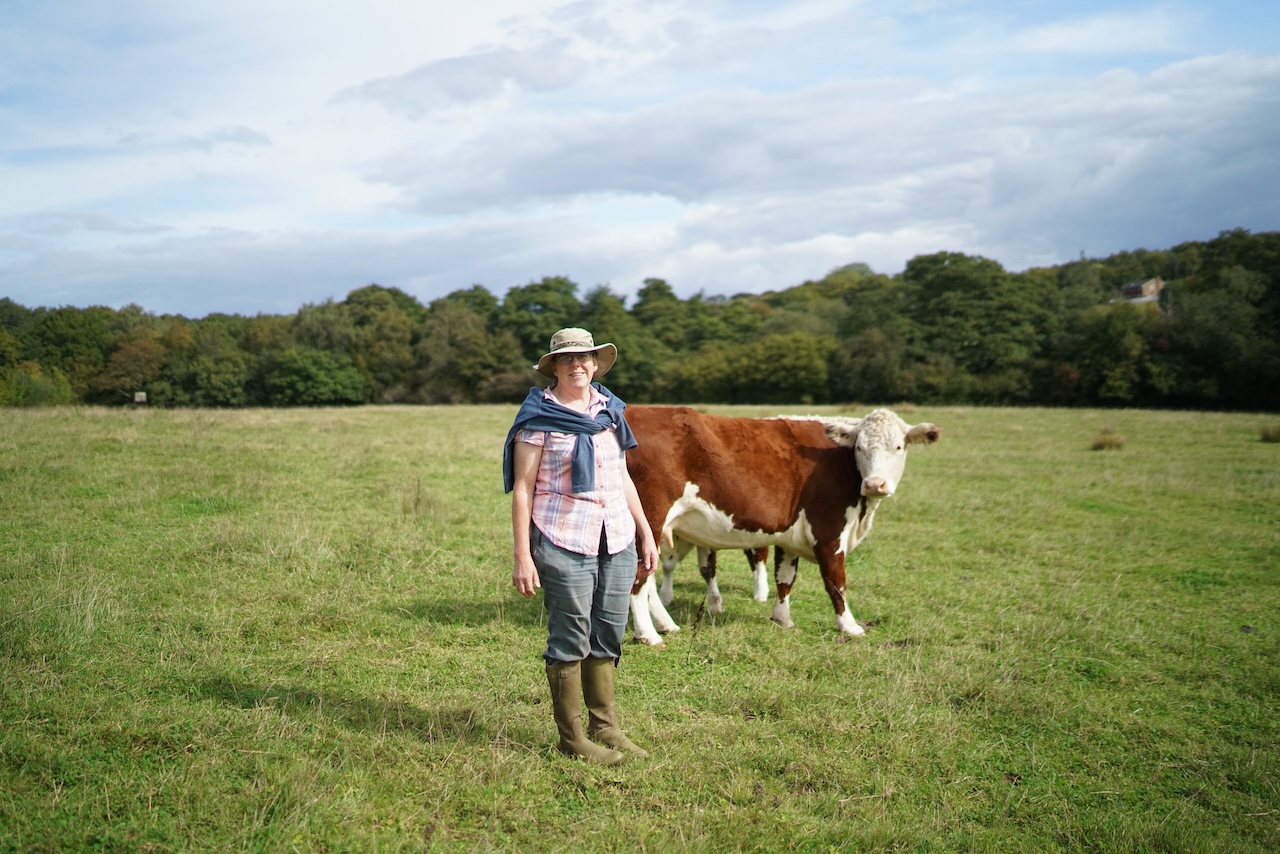

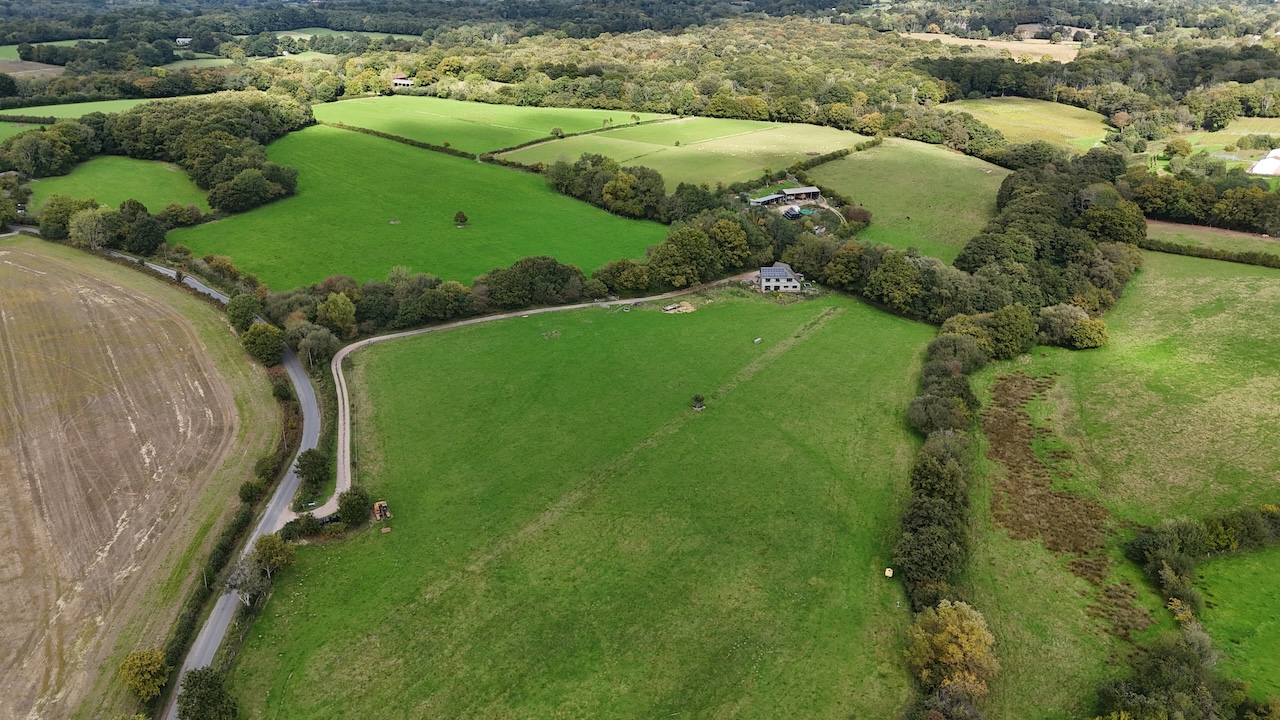
Brickpits Organic Farm, a 110-acre off-grid organic enterprise located in the High Weald near Uckfield in East Sussex, is no ordinary farm. Built from scratch in 1999 by Ian and Lynnie Hutchison on some bare arable fields, it is now home to a patchwork of pastures, hand-planted hedgerows, beetle banks, wildlife ponds and a timber-framed eco farmhouse they constructed themselves. Off-grid and organic from the outset, Brickpits has become both a family home and a resilient small farm.
In the third instalment of our twelve-part series supported by the Lund Trust and the High Weald National Landscape, we meet first-generation farmer Lynnie Hutchison to learn what it truly takes to build a farm from scratch. From navigating the shifting landscape of agricultural policy to upholding organic principles and shaping a viable family business, Lynnie shares an unfiltered account of the tenacity, compromise and ingenuity required to forge a future in farming today.
Neither Lynnie nor her husband Ian come from a farming family. In the 1990s Lynnie worked in countryside conservation, grazing sheep on SSSIs and nature reserves. A dog in need of training led to a few sheep, which grew into a flock and a business. For years they grazed odd parcels of “privacy land”, the ten or fifteen acres around big houses — in exchange for topping or fencing.
“But we always wanted to farm organically, and that’s hard on ground you don’t control,” she explained. “If we were going to do it properly, we needed our own place.”
When they found Brickpits Farm for sale they were able to get a loan from Triodos Bank, who have been amazingly supportive through the years. The land which had been mainly arable, contained a mix of clay and sandstone soils with very little in the way of hedgerows. Using an old tithe map, they set about reinstating field boundaries with thorny whips and fencing with chestnut stakes. “They’re twenty-five years old now,” Lynnie said. “We’re back to that pinch point where posts are rotting, fences need re-doing. Farms go in cycles — you’re always meeting yourself coming back the other way.”
Off-grid by design
Electricity never reached Brickpits at a viable price, so the Hutchisons decided to go off-grid from the start: rainwater harvesting from barns feeds a header tank and troughs; a solar roof doubles as the roof itself, with batteries and a winter backup generator.
“Most people don’t realise we’re off-grid,” Lynnie said. “We have the usual things — washing machine, dishwasher — we’re just more conscious.” More recently they retrofitted deeper gutters to the barns and extra tanks to cope with heavy rain and store more water for the droughts. “Climate change is moving faster than schemes and paperwork.”
Organic from day one
The farm runs a mixed system of sheep, cattle and arable. Most fields spend five or six years in herbal leys before rotating into barley; after harvest they’re sown with stubble turnips and then the following spring put into barley under-sown with a herbal ley to give clean grazing.
That dance has grown trickier. “Under-sown barley used to be straightforward,” Lynnie said. “Now the ley can outcompete the barley in odd weather. We’ve had to graze cattle over it gently as the herbal ley was too high in the barley to combine it. It worked, but it tells you how fast the weather’s changing.”
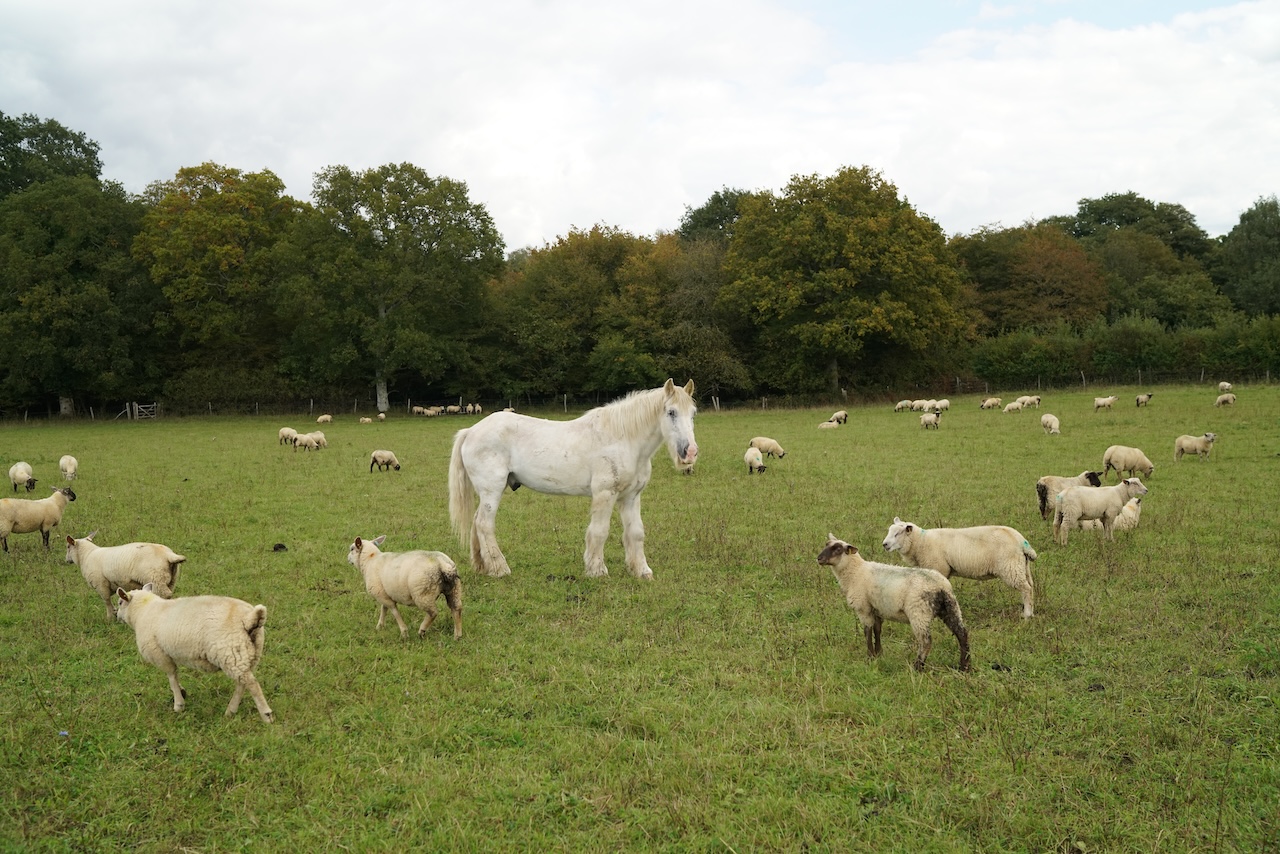
Stocking has eased back from 180 ewes to around 150. “You have to leave wiggle room. Even with clean grazing, the land can hold less in a drought year.” Breeds are pragmatic rather than purist, lambs finished steadily for direct customers rather than for a single lorry load. A small herd of native breed Hereford cattle thread through the rotation.
Farmer-led innovation on flystrike and homeopathy
Animal health is where Lynnie’s quiet curiosity comes alive. She helps run a Soil Association field lab testing natural preventions and treatments for flystrike — a perennial challenge for sheep farmers.
“Flystrike and internal parasites are the big ones,” she explained. “Yes, there are chemicals that work, but the data sheets are clear about handling risks and resistance. Even the BVA now advises targeted use, not blanket spraying. That shift matters.”
For readers unfamiliar with it, homeopathy in farming is about using highly diluted natural substances to stimulate an animal’s own resilience — more about supporting the whole system than curing a single symptom. “It’s not about magic potions,” Lynnie said. “It’s about observation — seeing when stress tips animals out of balance, and nudging them back.”
Their flystrike trial runs in three parts:
- A homeopathic combination to support overall vitality.
- A split comparison when pressure rises: split into thirds sheep get either of two herbal spray, others the farmer’s previous approach.
- An on-animal treatment — an essential-oil carrier that can be safely applied in the field.
“In the lab, 20% tea tree kills eggs and larvae. The question was: can we make it stick on a sheep and work in real life?” With help from a customer who works with essential oils, they developed a carrier oil that stays put. “You clip out, apply the oil — the maggots curl up and die. And crucially, you can do it safely with your hands while you’re in the field. That’s fit for purpose.”
Results vary: hoggets on a breezy hill did well with homeopathy alone, most groups of sheep went through last season on herbal sprays, while a group with mucky tails still got struck. “Context matters,” she added. “The future is using the right thing at the right time, with better options for treatment in the field.”
Water, trees and resilience
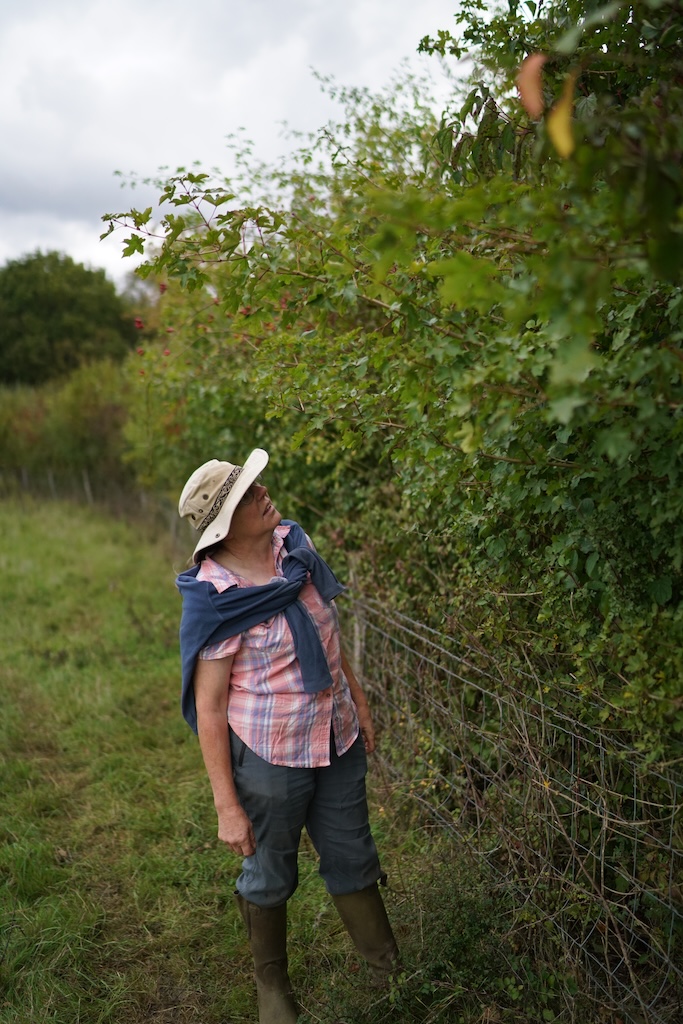
We walked past hedges heavy with hawthorn berries. “We’re seeing more heavy seeding after drought — a tree’s way of ensuring its future,” Lynnie said. Streams that once ran year-round now dwindle to puddles in summer. Big oaks drop limbs to save themselves. The response: more storage tanks, bigger gutters, and shade everywhere.
“Hedges were the best thing we ever did,” she said. “Every field has shelter. With heat stress rising, that matters.”
Climate change here isn’t an abstract chart but a set of daily decisions: how to catch enough water, when to move stock, what tools reduce stress. Lynnie explained how even subtle shifts matter. “Stress drives disease. Our whole approach is about reducing stress — calm handling, space to move, plenty of shelter. But weather is adding stress back in.”
That’s where homeopathy comes in again. During hot spells, Brickpits sheep drink trough water dosed with Sol (derived from sunlight) and Belladonna (linked to heat and inflammation). “It’s not a silver bullet,” she said. “But it can buffer animals through a tough few days. You notice calmer behavior, fewer knock-on health problems. For us, it’s another layer of resilience.”
Life without the Basic Payment
Like many small farms, the disappearance of BPS hit Brickpits hard. “I read somewhere it was basically the profit on most small farms,” Lynnie said were lucky our direct meat sales have always buffered us and now they’ve bridged the gap with hedge-laying grants, Lynnie’s work with Whole Health Agriculture, and the odd project that aligns with their values.
“We’re lucky to sell organic boxes year-round. It helps. But we’re not hiring staff. We train students, but in the end we have to help them find paid work elsewhere. That’s the hardest thing — the work is here; the money isn’t.”
Labels and the value of trust
Talk turns to labels. Brickpits has been organic from day one, and Lynnie is pragmatic about what labels mean on the ground.
“Organic is a whole-farm system — it fits us, because it’s about soil first, animals second, everything else following on. Pasture for Life is a good step for those wanting to move that way. Regenerative? In many ways we’ve been doing those principles since the start, “Organic is the only label enshrined in law with annual inspections.”
She worries that the proliferation of labels risks confusing the public. “Customers need trust more than jargon. They don’t all want to know the difference between ‘low input’, ‘pasture-fed’ or ‘regen’. They want to know the food is good for them, good for animals, good for the land. That’s what we try to show.”
Mental health, culture wars and community
Farming can be isolating: long hours, narrow margins, and a future that feels unsettled. Lynnie thinks the culture has shifted in the past twenty-five years. “Organic farmers were always quite collaborative,” she says. “Now I see more sharing across the board. Around here, if your tractor dies at 10 pm and rain’s coming, you can borrow a neighbour’s. When there stuck you take food, you muck in. That helps more than people realise.”
Direct sales add another thread of community. “We write to customers every three weeks. They write back. Sometimes they check in on us: ‘We read this in the news — is that affecting you?’ That human contact matters.”
On the darker side, she worries about where struggling farmers get pushed online. “I don’t spend much time on social media — no time — but I worry about the culture wars. We’re all human. The big problems — climate, biodiversity, health — don’t respect borders. If we each focused on the positive things we can do and built from there, it would add up.”
Politics, inheritance and the next decade
When talk turns to the future of UK farming, Lynnie keeps her answers close to lived reality.
“Farmers need stability to make change. Short-term politics doesn’t give you that. We need better information flows from places south of us already living in the climate we’re getting — and the flexibility to adapt fast. Food security should be part of that conversation, properly.”
She also raises a subject that quietly haunts many family farms: inheritance tax. “The value of land makes everything look bigger on paper than it feels in real life. Planning well costs money, and many small farms can’t afford the advice they’d need. You can end up working all your life to build something, only for the next generation to face impossible choices.”
Asked what she would say to government if she had the chance, Lynnie doesn’t hesitate.
“First, stop moving the goalposts. If schemes change every couple of years, you can’t plan rotations or investments. Second, reward the basics — hedges, water storage, shade — because those are the foundations of resilience. And third, treat small farms as an asset, not an afterthought. We may not move huge volumes of commodity crops, but we train new entrants, manage landscapes, and keep local food chains alive. That contribution deserves proper recognition.”
What keeps them going
Before I leave, I ask what keeps her hopeful. Lynnie looks out across the fields.
“The hedges,” she said with a laugh. “The water we catch, the way the farm has grown with us. Students with muddy boots and bright eyes. Customers who care. Neighbours who’ll turn out at ten at night because your baler’s broken.
“And the animals, when they’re well, moving through the fields the way they’re meant to. We chose this. It’s hard. You won’t make a fortune. But if you want a life outdoors, making food in a way that leaves the land a little better, it’s a good life.”
More Information
To help bring the series to life, I also filmed and edited video episodes from each of my farm visits, which you can watch over on my Indie Farmer YouTube channel. Click here to watch my episode on Lynnie.